Blog

Showing posts with label Research. Show all posts

3 Cautions For Adding Research Into Stories


By Jody Hedlund, @JodyHedlund

I'm currently in research mode for my next book. Since I'm a historical writer, research is an integral part of my writing process.

Usually I spend weeks researching and plotting before I write one word. The exact amount of time I spend researching depends upon my familiarity with the subject.

For example, when I write my historicals that are set in my home state of Michigan, my research is easier and less time consuming.

But when I researched for Rebellious Heart (based on John and Abigail Adams), I had to spend quite a bit more time learning about the era, setting, and characters.

Whatever the case, no matter what we write, we'll have to spend some effort researching, if not before writing, then at the very least during the editing to verify details.

I believe that research adds layers to a story. 

If we don't do much research, then our story is often paper-thin. We only skim the surface when we choose to write about occupations, settings, and subject matter that are more general or widely known, that require little to no research on our part. Usually, those kinds of stories don't stand out as much, are already familiar to our readers, and thus have the potential of being less memorable.

However, with each little bit of research we do about a unique job our character has, or illness someone faces, or lifestyle of a community, etc., we're able to add authentic depth to our story. Each layer of research builds upon the last until soon we have a richer, more complex tale that will transport readers into a fascinating story-world.

I recently finished reading Becky Wade's new contemporary romance, Meant to Be Mine. Her hero was a bull rider. I could tell Becky had done her research about career bull riders. I appreciated the freshness of her story and learning about a whole new world of bull riding that was foreign to me.

Perhaps not all stories will have the layers upon layers of research that go into historicals (like the War Brides, which I'm currently reading). But all books can benefit from the uniqueness and depth that comes from research.

However, when adding in those layers of research, I would urge a few cautions:

1. Remember the iceberg principle. 

When we research, we'll gain a LOT of knowledge. In fact, we'll likely gain WAY more than we need. I find that happens quite frequently. I'll read several long articles on a topic, but then only use one tiny detail out of all the information I've gleaned.

With the iceberg principle, we'll keep the majority of the knowledge under the surface and out of the story. Only a little bit will actually show up in the book. But that large foundation helps us be more confident and lends authenticity to our voice and to the aura of the story.

2. Keep it simple, but don't dumb it down.

When we add in our research, we don't want to confuse our readers with terms that they don't understand or a rambling of details that only an expert in that field can decipher.

On the other hand, we don't want to dumb down our research or terms. And by all means, we want to avoid inserting our authorial voice to explain something.

It's best to find a balance between being overly complex and overly simple. We need to use specific words and real descriptions, but in such a way that our readers can mostly grasp the meaning from the context of the setting or situation.

3. Insert details strategically. 

Everything we place in the story should add some value whether it relates to the character, setting, plot, or theme. Nothing should ever be thrown in randomly or haphazardly or just because we think it's interesting or because we want to show off our knowledge. Instead, the details need to serve a greater purpose.

We also want to avoid having big chunks of research information all in one place. Too much exposition (explanation), will cause readers to skim or skip ahead to the next paragraph of action or dialogue. We can keep our reader's attention and inform them at the same time if we weave in the little details in bite size pieces as a scene unfolds.

How about you? How much time do you spend on your research? Do you have any other cautions to issue regarding inserting research into stories?

How to Write Proficiently About Things You Don't Know


By  Jody Hedlund, @JodyHedlund

As writers, we're constantly told, "Write about what you know."

And yes, to a degree, this is very good advice. When we're intimately familiar or passionate about something, usually that enthusiasm will show up in our writing. We'll be able to write with more confidence. Our work will come across more authentic. And overall, we'll be able to lend more credibility to our stories.

We want to write in such a way that readers feel that they're actually in our story experiencing things right along with our characters. But how can they experience it, if we never have?

For example, a doctor writing medical suspense (like Doctor Richard Mabry), is going to have a much easier time with terminology, medical experiences, and the "can-this-really-happen" questions we all face when shaping our stories.

But does that mean that we always have to write about the things with which we're most familiar or have the most expertise?

I recently got an email from a sixteen year old writer having trouble with this very issue. She said: I have scenes where my heroine rides a horse and swims in the ocean, but I've never done these things. I lack firsthand experience. Do I write first, then edit my writing when I'm older, more experienced?

No matter our age, we will have times (perhaps many times), when we'll need to write about life situations for which we have absolutely NO knowledge or firsthand experience, especially if we want to infuse our stories with drama and life.

The truth is, most of us live pretty boring lives. We don't rescue girls from brothels, get trapped in the wilderness during snowstorms, get kidnapped at knifepoint, or end up in the middle of a bar room brawl.

Yes, all of these things happen in my new release, Unending Devotion. But I've never actually experienced any of them.

Does my lack of experience mean my book has a hollow ring to it or lacks conviction?

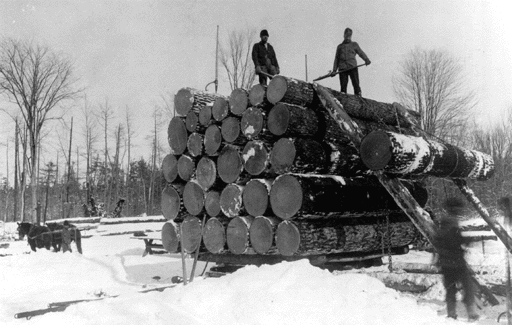
No. Quite the opposite. I've gotten feedback from many readers indicating how much they've enjoyed the authentic feel of the lumber era as well as all of the drama—in spite of the fact that I didn't live in the lumber era or experience any of the things I've written about.

So how do we write about what we don't know, especially with believability and proficiency?

1. Research, research, research.

I read as many books as I could about the lumber era in Michigan so that I was intimately familiar with the terminology and the experiences associated with it. During my research, whenever I ran across something interesting that happened to the "shanty boys" as they were called, I made a note of it, like icicles forming on mustaches or the sound that the trees make when falling. All of those tiny details add authenticity.

With the invention of YouTube, we have the opportunity to "experience" almost anything. For example, I've never gone Polka dancing, but I needed to see how it was done for a scene in my upcoming release A Noble Groom. So I watched several YouTube videos of Polka dancing and got a pretty good idea of what it entails.

2. Read biographies.

To get an even better feel for the experience, I read biographies of people who lived during the lumber era. Biographies give us a more subjective view of the experience, how someone actually felt about what they were going through. I keep notes of the various emotions and reactions that I can use with my characters as they go through a similar situation. (Contemporary writers might consider interviewing a real person for a subjective view.)

3. Let the imagination make the experience even more dramatic.

We can't translate real life happenings into fiction verbatim. Fiction is, well . . . fiction. Of course we want to keep the element of plausibility, making certain we have set the foundation, motivations, and setting for all the drama.

But ultimately, we must always have more things happen to our character (usually negative) in the course of 300 plus pages than one person would ever really experience. And then we make those events and situations larger than life as well. For example, if our character rides a horse, it will contain true elements, but if it's an important horse ride, we'll want to make it really scary, or really fun, or really life-threatening.

4. Let qualified beta readers give us feedback.

Sometimes it helps to search through our cache of friends and track down someone who has experience with the subject matter. Then we can ask them to read a selection and check for accuracy of our work. They aren't editing for us, but simply making sure that we did indeed portray the character or situation the way it really would have happened.

5. When in doubt, leave it out.

If I've exhausted my research and can't seem to find a way to authenticate something I want to include, then I'll usually leave out the scene or revamp it to weave in something I have been able to find.

Do you ever have to write about something you don't know? How do you make your story believable and authentic?
_____________________________________________________________

Hey everyone! My "Fun Secrets" Blog Tour is still taking place. Don't miss out on the fun! At each blog stop, I'm GIVING AWAY a copy of my newest release, Unending Devotion. Here's where I'll be over the next few days:


Thursday, Sept. 20:  Secret #12: My secret for writing around my kids. Marie Burton’s blog Burton Book Review

Friday, Sept. 21: Secret #13: The house chore I like to do the least. Lily Robinson’s blog

For a list of all my secrets, check out my Events Page!

How Should Writers Research? All at Once or As Needed?

Almost all writers have to engage in research. Of course some genres will require a bit more digging than others. But generally, research is an important tool for adding authenticity and depth to any kind of story.

When we take the time and effort to add realistic details, we're better able to give our readers an enlightening and more enjoyable reading experience. In fact, some of the most memorable stories are those that transform us to another time and place. They’re the kind that when we turn the last page, we come away feeling as if we gained something for having read the book.

Even contemporary novels need research. Last month I was privileged to read Katie Ganshert’s debut novel Wildflowers from Winter (releasing in May). I don’t read many contemporaries, mainly because my passion is reading and writing historicals. But as I was reading hers for endorsement purposes, I was struck by the level of research she’d done in order to bring some of the farm scenes to life.

Yes, no matter the genre, research is important. If you’re not doing any, why aren’t you?

Recently Jim asked me this question about how I research: “Do you write first and research when you need it, or do you try to get all your data compiled in advance so you have your resources already in line?”

I don’t think there’s a right or wrong way to do research—except that we make sure we ARE actually researching and that we’re doing it thoroughly with reliable sources. But since I’m deep into research for my next novel, I’ll offer a few of my thoughts on research (as long as you make sure you chime in with yours!):

1. Before writing, research the big-picture stuff.

I spend many, many weeks researching before I start a first draft. Of course, that’s part of the nature of writing historicals. But I think all of us—no matter our genre—can benefit from developing an intimacy with story details before we begin our first draft.

When we lay a foundation, we’re able to build the story more solidly and naturally. The words will flow with more confidence and credibility. In fact, that initial research often sparks ideas for plot twists and turns.

The trick is knowing when we finally have enough research to start our story. We don’t want the fear of not having enough information to keep us from writing. Even if I don’t know everything, I usually reach a point when I finally feel immersed into my time period and setting that I can write about it with a degree of knowledge.

2. While writing, try not to interrupt the story flow.

Once we start the first draft, we should try as much as possible to keep the flow of the story going. Our creativity needs permission to proceed without hindrances. Often writers get “stuck” because they’re letting their internal editor have too much freedom during the first draft. When we constantly stop the story to nitpick a word, or to research types of underwear, or to find out if our heroine would have been drinking tea or coffee, we risk inhibiting the muse.

Obviously we can’t anticipate every piece of research during the planning phase of our books. We’ll invariably run across things during our writing phase that need further research. I try to determine if the information is integral to the plot. If so, then I stop and research as much as I need to keep going but no more than that. If I don’t need the particular piece of information at that point, then I highlight the word or put a bubble into the margin with a note to remind myself to research it later.

3. During editing, polish up the small research details.

Editing is the time when we want to analyze and check accuracy of details. So while my mind is in edit mode, I go through my document and spend time researching everything I’d previously put off. In fact, as I re-read my story, I keep a running list in a notebook of all the things I need to research further.

When I wait until the editing phase to finish researching, not only do I find myself being able to write a faster first draft, but I also can write that first draft with less frustration. I know I’ll get to particular details later which allows me to enjoy the story more.

Your turn to chime in with your advice on researching! What do you think is most helpful? Writing first and researching as you need it? Or researching first and then writing?

4 Tips for Researching a Novel

Research is an integral part of the writing process for most writers. I write historical novels and as you can guess, the research process is quite extensive. Whether we write thrillers, suspense, or contemporary romance, we’ll all have areas within our stories to research.

Granted, contemporary genre writers may have fewer things to research than a historical writer like myself, especially if they’re an expert with the subject matter. For example, Dr. Richard Mabry writes romantic medical suspense. After practicing as a medical doctor for many years, he weaves his firsthand knowledge into his stories. He obviously doesn't need to expend much effort researching the medical aspects of his stories.

Most of us, however, aren’t experts in all the various topics we want to thread into our stories. And so we resolve ourselves to the fact that research will indeed be part of the writing process much the same way editing is. Research adds authenticity, depth, and interest to our stories.

Fortunately, in this day and age, most of us have the benefit of the internet. A click of the keyboard can unleash more information than we can possibly use. And yet there are times when the research process can become overwhelming and even bog down our writing if we’re not careful.

Occasionally, I get asked about my research process. I certainly don’t claim to be the expert researcher! I’m sure there are many others who are much more proficient at it than me. But I’ll share a few of my research steps (and in the comments, I’d love to hear your tips!).

1. Set the foundation before beginning the first draft.

I spend approximately two months researching and plotting before I’m ready to begin writing the first draft. Intensive upfront research is usually more typical of historical writers. We have to become familiar with the time period, search out appropriate plots, and understand the motivations of characters from long ago. I often read several biographies, search out original documents (like diaries or letters), and read books about the big topics within my story.

All of the initial research helps lay the solid foundation for the development of the plot and characters. We immerse ourselves into the setting so that when we start writing it flows naturally, as if we're already comfortably living in that time and place.

2. Try not to let the ongoing research stop the story-flow.

Once I start the actual writing, I try not to stop too often to look up information. If I come to a point in the story where I don’t know something, I often highlight the word or phrase so that I can come back to it later, or I make a note in the margins. When I switch settings between scenes or chapters, sometimes I may need to do additional research in order to get a grasp of the setting. I’ll take an hour or two to get enough of what I need to proceed. But I try not to linger too long over the research so that I don’t hinder the flow of the story.

3. Go deep but stay narrow.

The Preacher’s Bride is set in the 1600’s. And my second book, now titled The Doctor’s Lady, is set in the 1800’s. Two different time periods. Two completely different settings. I’m not an expert in either era or place. Sure, I’d probably make life easier for myself, if I stuck with one particular time period in history and became an expert on it. But at this point, that’s not apart of the program!

Instead, I try to narrow down exactly what I need to know for my particular story. I don’t have to learn everything about England after the Restoration. I lay the beginning foundation as mentioned above, but I don’t need to acquire a PhD in English Civil War history in order to research the pillory and its usage for the poor of the 1600’s. I dig deep for what I need and don’t get side-tracked by all the rest.

4. Keep a record of all documents and research.

At the beginning of each new novel, I open a three-ring binder specifically for research. I divide it into several main categories. And as I research, especially online, I print out information, three-hole punch it, and stick it into my binder. Then I can easily refer back to it during the story. I also keep a running bibliography of all of the books I’ve used.

I’ve realized now how important it is to save a record of all the research. During the line and copy editing phases of the publication process, we’ll be asked to verify the tiniest details. Having those links, books, and pages at our finger tips can save us effort later.

Your turn! How much effort do you put into research? And are there any other methods or tips that help you in the research process?
© All the articles in this blog are copyrighted and may not be used without prior written consent from the author. You may quote without permission if you give proper credit and links. Thank you!